writing when English is not your mother tongue

I experienced nirvana Wednesday evening with my small writing class. When I called time for the five-minute freewriting prompt, they protested. They wanted more time. Is there any more celestial music to a writing teacher’s ears than her students’ clamor to keep writing? I think not.

Several of these students talked about the challenges they face writing in English when Spanish is their mother tongue. They talked about not being able to find the right word. When they wrote in Spanish, they found the words they wanted. Those words were richer, more evocative–righter. I know “righter” is not a word, but it seems to fit here.

And “righter” reminds me of a story my dad told just a few years ago. His mother, a Palestinian who spoke English with a rich Arabic accent and who taught her granddaughters songs in French, a language she knew better than English, used to say when they were in traffic: “Let that car go ahead. They have the righter way.” In a world of perfect Oxford-dictionary English, my grandmother would have said, “They have the right of way.”

But you know what? Her phrase makes more sense. She uses a non-word, a neologism, and it’s more economic than “right of way,” sounds better, is logical, and a bit poetic.

And that’s the gift that non-native speakers of English own–a built-in, ready-made, linguistic transformer that creates new words, sounds, content, syntax. Don’t misunderstand: I do not belittle the challenges of writing in another language. I’ve done it. It ain’t easy. I don’t belittle the challenges of living in a culture whose language you don’t know well. And I don’t belittle the pain that linguistic chauvinism visits on too many Americans who speak with accents or limited fluency in English: How do you navigate a  culture that denigrates or represses your mother tongue?

I grew up in a time when learning another language marked someone as educated. These days, we’re lucky if the public school has an art program, let alone a few years of Spanish or French, Latin or German, or even Arabic or Japanese.

So let me name some writers who have written in a language other than their native language. Joseph Conrad, author of Heart of Darkness, a novel considered by a number of scholars as one of the top ten written in English, knew English as his third language; Polish was his mother tongue and French came second. Another Polish-born writer, Anzia Yezierska, wrote her novels in American English and incorporated Yiddish into her stories of life in New York’s Lower East Side. A more contemporary author, Judith Ortiz Cofer was born in Puerto Rico and publishes in her second language, English. A novelist, poet, and young adult writer, Ortiz Cofer’s collection of essays called Woman in Front of the Sun: On Becoming a Writer is an inspiring read.

And Chinua Achebe, the Nigerian novelist who just died last March and wrote a central piece of criticism on Conrad’s novel (“An Image of Africa: Racism in Conrad’s Heart of Darkness), wrote not in his mother tongue, Igbo, but in the language of the colonizers, English. And he reveled in the transformations his Igbo-shaped writing would contribute to literature written in English.

Let me end with some wisdom on language from the great Jamaican poet, Louise Bennett, in her poem, “Bans O’ Killing” (“Lots of Killing”), which responds to a threat to kill Jamaican English by detailing what would happen to the English language if dialect were killed off:

Yuh wi haffe kill de Lancashire

De Yorkshire, de Cockney

De broad Scotch an de Irish brogue

Before yuh start kill me!


Yuh wi haffe get de Oxford book

O’ English verse, an tear

Out Chaucer, Burns, Lady Grizelle

An plenty o’ Shakespeare!


When yuh done kill “wit” an “humour”

When yuh kill “Variety”

Yuh wi haffe fine a way fe kill

Originality!


writing improves your health

I’m reading Louise DeSalvo’s Writing As a Way of Healing: How Telling Our Stories Transforms Our Lives, and in chapter two (“How Writing Can Help Us Heal”), DeSalvo details the experiments of James Pennebaker, a psychologist who studied groups of students (at Southern Methodist University, where Pennebaker, and his associate, Sandra Beall, both taught), who wrote in a journal for fifteen minutes, four days in a row.

One group of students wrote about traumatic experiences, but this group was divided into three, with the following guidelines: 1) write about the trauma and the emotions, 2) just describe the trauma, and 3) write about the events and the emotions of the trauma at the same time.

Guess which group initially felt negative feelings but four months later, said they had a much more positive outlook, and six months later, showed improved health (visits to student health center dropped 50%)? You guessed it–group 3.

In DeSalvo’s words, here are Pennebaker and Beall’s findings:

  • to significantly improve your spirits long-term, you must endure difficult feelings initially

  • To improve health, we must write detailed accounts, linking feelings with events. (22)

DeSalvo offers a caveat in this chapter: If you’re going to write about trauma, be sure you’ve got support (support group, therapy, dedicated listener).


new year, new journal

Although “I write in a journal” is perfectly good English, I prefer to use “journal” as a verb, as in, “I have already journaled today.”

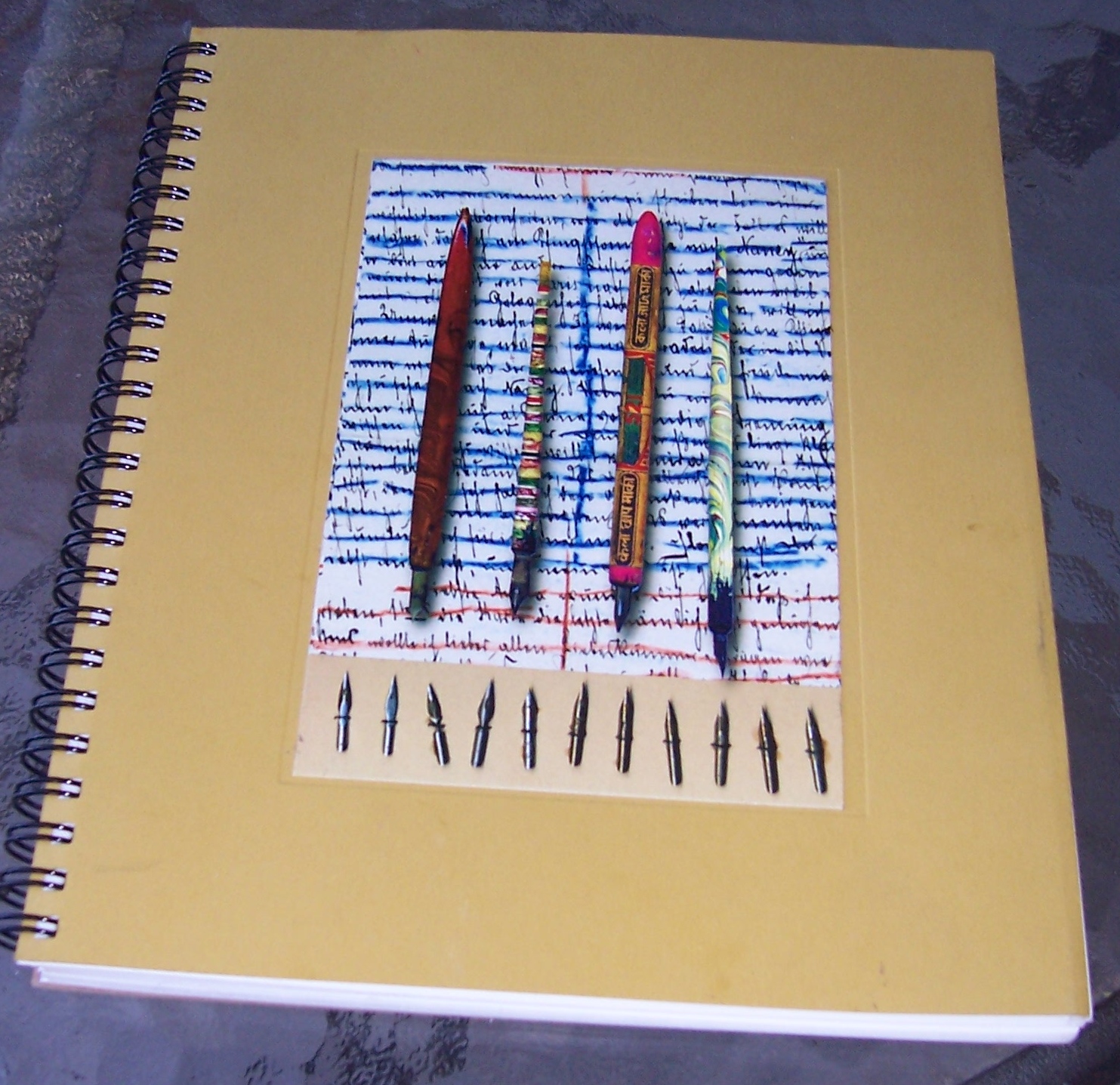
And I have. Here’s my new journal:

100_4117It’s not brand new. I started it on 23 December. I prefer unlined pages and a binding that allows me to fold the pages back, so I have an easy surface to navigate. I can hold the journal on my lap or place it on an airplane seat tray and write in comfort.

I’m unhappy when I don’t have access to journals that make me smile. Lucky for me, moving back to Tucson gives me easy access to Antigone Books, where I used to buy Bandolier and then Rhino journals. Bandolier no longer makes their gorgeous bound books, and Rhino journals are now made in China. But I’ve found my replacement–journals from Ganapati Studios. Perfect.

Journaling is an art, a joy, a necessity. Susan Wittig Albert (author of the China Bayles’ mystery series) recently published An Extraordinary Year of Ordinary Days, her journal for 2008. Wittig Albert tells us at the start that she begins each new year with a new journal to also mark her birthday on 2 January.

Why bother to buy someone else’s journal? Because the writing is inspiring. We see Wittig Albert’s amazement as she discovers how certain areas of her life have become more urgent (paying more attention to the environment), we travel with her between New Mexico and Texas, we share in her deep reading as she adds quotations in the margins.

Journals are travel guides through a writer’s thinking and feeling journeys.

What kind of journal do you use? What utensils? What tickles your writing muscles?

And if you’ve ever resisted writing in a journal, check out an irreverent version in Keri Smith’s Wreck This Journal.

feedback

Writers need effective responders.

I use “responders” instead of “readers” because that’s what we need–readers who can respond to our writing in ways that help us to revise.

Responders are our beta testers.  Any application or product needs testers to try out the product and report back to the creators–this works, this doesn’t work so well, I’d like to see this feature. First (and second and third and fourth) drafts are our beta versions, and we need to send them out into the world with all their glorious glitches.

But being indiscriminate about who reads our drafts does not serve our craft well. A crucial skill we develop is how to get effective feedback.

Maybe you recognize some of these less-than-effective types of responders:

  • the appropriator – This responder reads your work as if it were his or hers. These responders don’t listen to your writing. They only hear how the piece should be shaped according to their writing. “Rewrite this in first person. First person is always fresher than third person.” “You need to focus on the background of this environmental disaster, not on the people involved.”
  • the detonator – This responder bombs your work and says it’s for your own good. “This is a cliché.” “Use active voice.” “Never begin a sentence with ‘but.'” “I know you can take this criticism.”
  • the teflonator – This responder slides  your writing off his or her reading surface as smoothly as a well-greased egg. “This is good. I like it. Wow. Great job.”

You know when you’ve found a good reader. When you read the comments or discuss your writing, that person echoes your inchoate sense of where your writing works and where you need to revise. We all have that writer’s revisionary sense–“Something’s not quite right here.” Effective readers articulate those somethings.

If you don’t have effective readers, here’s the good news: You can train them. In fact, it’s your job as a writer to be specific about your feedback requirements: “I need help with organization. I’m not sure if I should approach this topic chronologically or thematically.” “This character’s voice is not convincing. Where does the voice ring true to you? Where does it seem off?” “I’m missing an introduction and am at a loss. What would you like to see at the start?”

I like the schema used by the National Writing Project for its electronic anthology, open to all participants of summer institutes. The anthology is a huge online space for getting feedback on writing of all genres. Writers can ask readers to bless, address, or press.

Ask a reader to bless your work. You only want to hear what works or what the reader likes.

Ask a reader to address your work. You offer criteria you’d like the reader to attend to.

Ask a reader to press your work. You want the reader to be meticulous about each area that needs revision.

Effective responders need to be skilled at hearing their own reading voices. When they read, they need to be able to notice their “aha” moments (“That metaphor gives me chills”), and their confusion (“I’m not sure of the timeline here”), and where they need more information (“I want to know what this character looks like”), and then be able to tell the writer that script of their reading experience.

Maybe one of the best ways to find or train these kinds of readers is to become one yourself. Read other writers’ works and develop the skills you want responders of your work to possess.

It’s sacred stuff we’re doing here. Offering our work for response and responding to another writer’s work takes care, time, honesty, and love.

books on writing

What is your most beloved book on writing?

We all have them–the worn paperback, pages glazed with yellow highlighting, margins crowded with scribbled notes. The books we hold in our heads, in our composing muscles–these guides have taught us our craft.

The pages of these books contain our “aha” moments. We recognize a long-practiced tic that impedes our readers’ comprehension or delight. (Hey–who knew that “just” does not need to be inserted before every other adjective?) That’s the first step–discovery. These beloved writing books teach us to investigate our own practices. And when we find aspects of our craft that need help, these books tell us how to improve. Concretely. With really good examples.

I could list several most beloved books on writing, but I’ll stick with one for now: William Zinsser’s On Writing Well. Originally published in 1976, the 30th anniversary edition contains Zinsser’s short introduction detailing the changes he’s made over the three decades and six revisions of the book’s publication history.

One of my favorite chapters is called “Bits and Pieces,” which ranges from adverbs to punctuation, from “creeping nounism” to credibility. Here are the first two paragraphs of a section called “Little Qualifiers”:

Prune out the small words that qualify how you feel and how you think and what you saw: “a bit,” “a little,” “sort of,” “kind of,” rather,” “quite,” “very,” “too,” “pretty much,” “in a sense” and dozens more. They dilute your style and your persuasiveness.

Don’t say you were a bit confused and sort of tired and a little depressed and somewhat annoyed. Be confused. Be tired. Be depressed. Be annoyed. Don’t hedge your prose with little timidities. Good writing is lean and confident. (70)

If you don’t have a beloved book on writing, go find one. I envy the joy you’ll feel in a first-time reading of Zinsser’s book. But the best thing about these writing guides? As in any relationship, that initial flush of discovery turns into the solidity of a long-term friendship as we return again and again to the wisdom and guidance in these pages. Here are some of the books I consider friends (the list contains a range of books that inspire me–they’re not all writing guides or how-to books):

Anne Lamott, Bird by Bird

Natalie Goldberg, Writing Down the Bones

Renni Brown and Dave King, Self-Editing for Fiction Writers

James Scott Bell, Plot & Structure

Raymond Obstfeld, Novelist’s Essential Guide to Crafting Scenes and Fiction First Aid

Louise DeSalvo, Writing As a Way of Healing

Julia Cameron, The Artist’s Way

Keri Smith, Wreck This Journal

Donald Murray, The Craft of Revision

Brenda Ueland, If You Want to Write

neologisms

Neologisms illustrate that language morphs. Neologisms can also be wicked fun.

Merriam Webster’s offers two definitions: “a new word, usage, or expression” and “a meaningless word coined by a psychotic.” Hmmm. The word derives from the French, néologisme–né means “born,” and so we have the birth of a new word or phrase.

“Bootylicious” and “soccer mom” win two out of the eight places in Emily Temple’s article at Flavorwire, “The Story Behind 8 of the Most Irritating Neologisms,” a source I found after googling “famous neologisms.” And “google” as a verb is listed as a neologism in “54 Great Examples of Modern-Day Neologisms.” These examples also prove that in order for a neologism to be fully born, it must be used. A lot.

Two current examples serve as neologisms because they’ve garnered new-found celebrity: “iconic” and “meme.” I encountered “icon” and “meme” in my literary criticism classes, where an icon was a sign (semiotics) or a symbol, and a meme belonged to mimesis, or the art of imitation and representation. Notice that the adjective form of “icon” is the current neologism. Listen to the nightly news, and I swear, you’ll run screaming from the living room after the twelfth pronouncement that something is “iconic.” Because “iconic” and “meme” have switched academic addresses to established social media residences, I think they qualify as neologisms.

Word play. Oxymorons (“jumbo shrimp”), portmanteaus (“brunch”), and dare I say, the lowly pun (as Mercutio dies, he says, “Tomorrow … thou shalt find me a grave man”)–these all indicate what we linguistic beings know: language can be a blast. The joy of messing with it, transforming it, re-creating it–that’s a creative rush.

The wicked fun part is celebrated by The Washington Post’s weekly Style Invitationals, which may ask you to create a neologism by offering a new meaning for a word or by altering a word (change one letter or spell it backwards, for instance) and then giving the new definition. Example: coffee (noun) – the person upon whom one coughs. Ha! Check out the archives for each weekly invitational and treat yourself to some wordy guffaws.

And now for another neologism, one that I believe should become an iconic meme. My youngest sister, MJ, came up with the word perplangst. At first, she thought of “perplangsty,” a portmanteau using “perplexed” and “angsty.” “Angsty” is itself a neologism, transforming the noun, “angst,” into a new adjective, “angsty.” But “perplangsty” just doesn’t sound right.* The solid ending of “perplangst” offers a definitive jitteriness, I think. So MJ revised her neologism. If you’re confused some time today, and you’re fretting about being baffled, go ahead–say it: “I’m so perplangst!”

*If, however, you are using the word in a derogatory manner, adding the “y” to the end seems appropriate, as in, “Don’t get all perplangsty on me now!”

National Day on Writing

Today is the National Day on Writing, a celebration proposed by the National Council of Teachers of English and supported by Congress in 2009, 2010, 2011, and 2012. We’re still celebrating this year even without Congress’s support (sound familiar?). I think it’s a big deal when our government says to a bunch of English teachers, “Hey, yeah. Nice work. Let’s celebrate this thing called writing. Did I use that comma right?”

This year, the theme is “Writing to Connect.” Most of us are focusing on how we write to connect with others, but I’d like to remind us all of how important it is to use writing to connect with ourselves. How do I do that? By writing in my journal every morning–or almost every morning. If I’m disconnected from myself, chances are I’m not going to be able to connect very well with anyone else.

I like the honesty journaling allows me–the brain and heart and soul room to write through to what’s bugging me, to what I want to celebrate, to the mundane moments no one else will notice. Those silly quotidien yawn things–feeding the cats, wondering if the $12.99 reading lamp I bought will ever steady its light, thinking I can put off a haircut for another three weeks–those things that are important to no one else, they get noted on my unlined paper. And when I note those sillinesses, I often uncover platinum insights–about my own character challenges, about an amends I want to make, if I’m afraid of death this moment and why not. #write2connect #pimawrites

I have no clue

what to post. And there you have the writer’s dilemma–that infamous blank page. The blank page is a ten-pound weight we pick up and lift and press again and again. It’s how we work out. We stare at the blank page. We put down text. We stare. We write. Five, ten reps. Ten sets. We practice.

Fortunately, we have tools to help us with that blank page, whether the page is a college essay, an article we’ve agreed to write, or a memo that needs to go out in a half-hour. One of those tools is freewriting. Freewriting is a kind of brainstorming or pre-writing, but it can be used at any stage of the writing process to nudge you further into your project or writing task.

I take my freewriting guidelines from Natalie Goldberg’s Writing Down the Bones and Wild Mind. Goldberg uses the phrase “timed writing practice” and asks the writer to commit to a certain amount of time–five minutes, twenty minutes, an hour. Once the writer commits to the time, here are the guidelines:

  1. Keep your hand moving.
  2. Lose control.
  3. Be specific.
  4. Don’t think.
  5. Don’t worry about punctuation, spelling, or grammar.
  6. You are free to write the worst junk in America.
  7. Go for the jugular.

If you want to know more about these guidelines, check out Goldberg’s work.

taking risks

Some students have asked me if writing about going to jail is a valid topic for a personal narrative essay. I think I know what they’re really asking: Will you judge me if I write about this experience?

Writing honestly about one’s life takes guts. These students have the courage. I know they do. They also know–somehow they know in their cells–that sharing their writing will heal some part of themselves and their readers. I can see in their eyes that they want to write about this experience. But they want my blessing. I can give that. I can, however, give them no guarantee–that they won’t be judged by some readers, that their writing will give them peace.

I can guarantee that if they write to the best of their abilities, and if they write honestly, they will be moved–their readers will be moved. Somebody’s going to learn something. Shift will happen. Tiny blessings will spark, like those June fireflies that pinpoint nano-seconds of brightness in the dusk of summer.

language in transition

Language morphs according to our needs. What was incorrect decades ago may now be correct.

Here’s one example of language in transition–pronoun-antecedent agreement. The following sentence is grammatically correct:

Everyone should bring his or her jacket to the game.

But if you utter this sentence, won’t you sound like a snooty reject from the English Honors Society? Yes. You will.

We say, “Everyone should bring their jacket to the game” because we’re talking, and we want to communicate–not stop and check whether or not our pronoun agrees in number with the antecedent noun.

But will your first-year writing college instructor deduct points if you write the second sentence instead of the first? Yes. Maybe. It depends.

Check out this talk by the Merriam Webster Word Nerds (my pet name for these language wizards). I love that these short videos focus on language in context–not on language as an absolute. Watch as Emily Brewster, Associate Editor at Merriam Webster, discusses “The Awkward Case of ‘His or Her.'”

My favorite illustration of language in transition occurs during Gentlemen Prefer Blonds, when the character played by Marilyn Monroe points to a poster with her name and says, “It is I.” If you’re like me, you hear that sentence and can’t believe it’s coming out of Marilyn’s mouth. But in the 1950s, this grammatically correct sentence sounded natural. No one sitting in a movie theater in the 1950s would have flinched. But when you answer the phone today, how often do you say, “It is I.” Again, echoes of that snooty English Honors Society outcast.